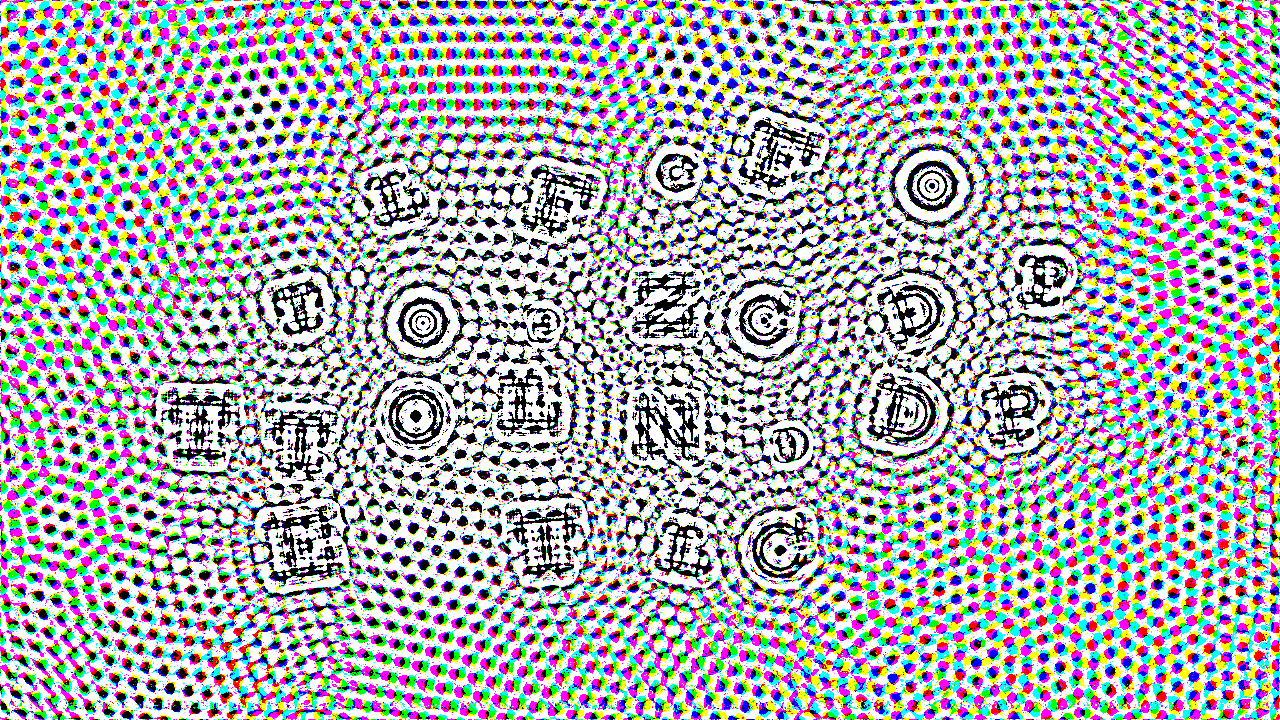
The letters are never printed
Nothing in the left-hand image is a letter. It is speckle, solved pixel by
pixel so that blurring it reconstructs the letter field. Blur throws
away high spatial frequencies; the solver hides everything it needs in the
frequencies that survive.
Colour that disappears
Red, green and blue are solved as three independent problems from slightly
different starting noise. Where they disagree you get colour; where they agree
the letters emerge. Under blur the disagreement averages out, so a vivid print
resolves to neutral black on white.
Swirl, not static
Every sixty steps the solver blurs its own working image, compounding fine
speckle into coarse marbled swirl. Graining runs to 95% of the run — stop
earlier and the clean polish that follows sands the swirl away.
Why big radii score worse
Correlation falls from 0.998 at radius 1 to 0.79 at radius 46. More blur
destroys more information, so there is less of the letter field left to
rebuild. The curve you drag along is that limit, measured.
View it at full size
The prints are served at their native 1280×720 and the effect is real
only near 1:1. Zoom the page, or view it on a narrow screen, and the
browser's rescaling folds the speckle into moiré rings that are not in
the artwork. The radius is in printed pixels, so it scales with the print.
Optotypes set in Snellen; labels in Optician Sans. Each radius warm-starts from its
neighbour, one step at a time, out from radius 16.